Guide
How to Size a Dust Extractor for Your Concrete Grinder
Airflow, circuit and hose decide whether an extractor keeps up with your grinder. Here is a simple way to match them before the dust starts flying.
· 4 min read
How many CFM does a concrete grinder need? A common planning rule is about 25 CFM per inch of wheel, so roughly 125 CFM for a 5" cup and 175 CFM for a 7". An extractor that is too small does not fail all at once. It keeps running, the shroud starts leaking a little dust at the edges, the filter loads faster, and by mid afternoon the air in the room is grey. Sizing it right at the start avoids all of that.
Three things decide the match: airflow, the circuit you plug into, and the hose between the shroud and the machine.
1. How many CFM for a 5" or 7" grinder
A rule of thumb many contractors use comes from the US silica standard: about 25 CFM of airflow for every inch of wheel diameter. It is not a BC rule, but it is a sensible floor for planning. For what WorkSafeBC expects, see silica dust when grinding concrete in BC.
5" cup wheel: about 125 CFM
7" cup wheel: about 175 CFM
Two hand grinders on one extractor: add them together
Treat these numbers as the minimum at the shroud, not the number on the box. A long hose, a loaded filter or a tight bend all cut the airflow that actually reaches the wheel. Leave headroom.
If you run a walk behind floor grinder, use the airflow its maker specifies. Floor grinders vary too much for a simple rule.
2. 110 V or 220 V: check the circuit first
The most common job site problem is not suction. It is a tripped breaker. A machine that draws 16 A will trip a shared 15 A circuit, especially with a grinder on the same line.
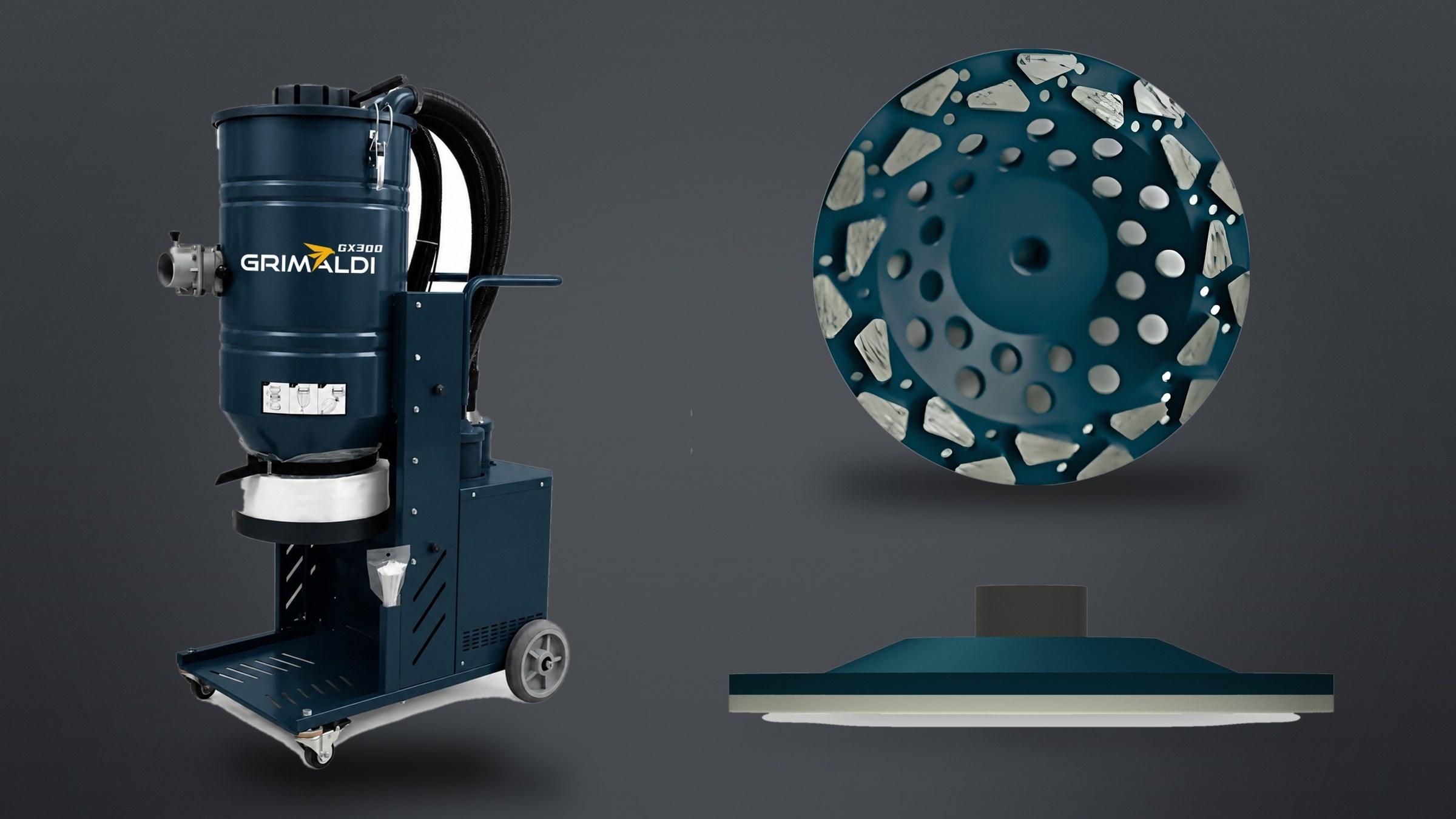
110 V jobs on a standard circuit: the GX300 three motor extractor has the lowest draw in the Grimaldi line at 14 A, with 330 CFM.
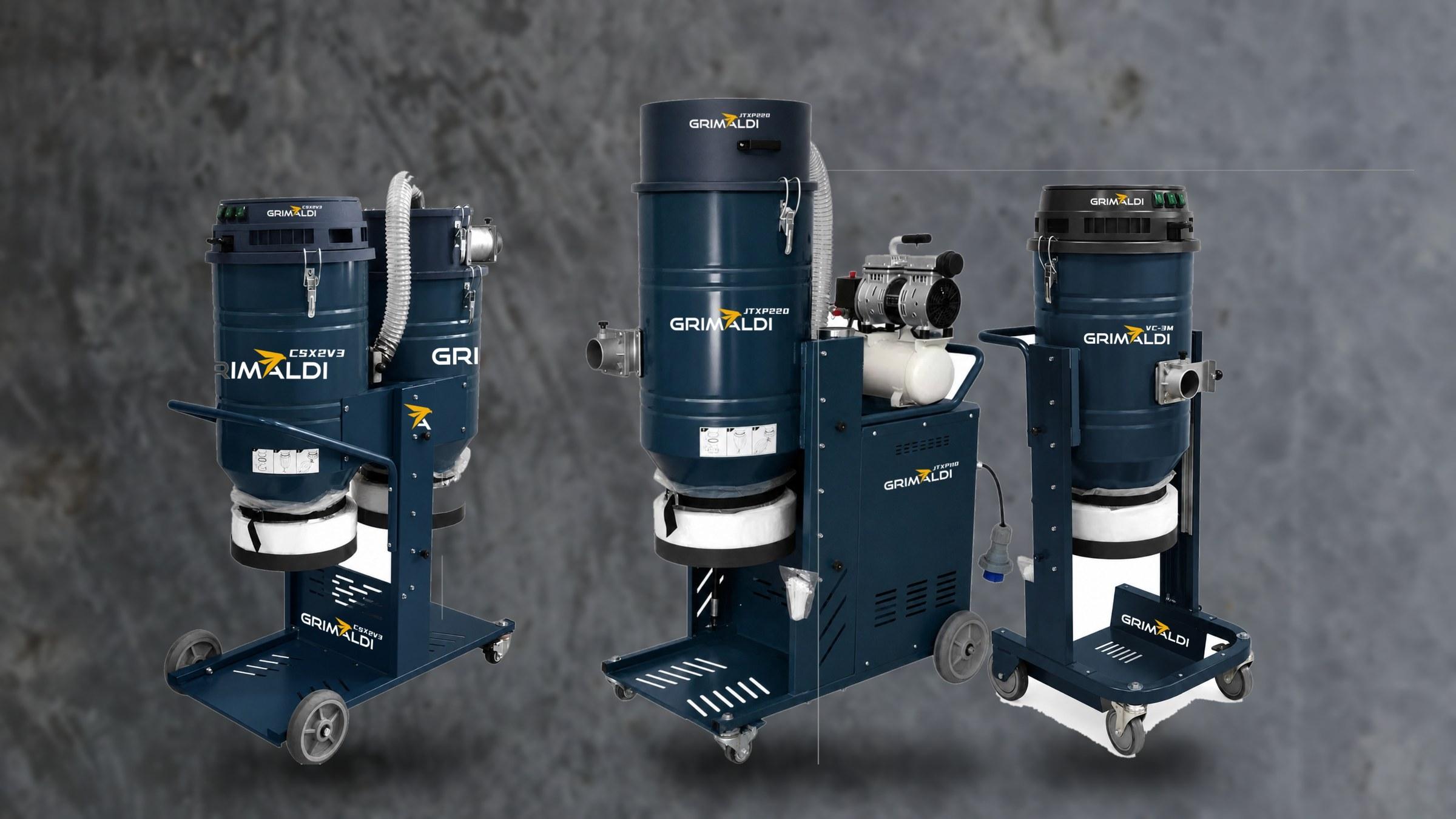
110 V with a dedicated 20 A circuit: the CSX2V3 (330 CFM, 16 A) or the VC-3M (350 CFM, 16 A).
No 220 V on site but you want a turbine: the JTXP110 gives 220 CFM on 110 V. Plan for its 21 A draw.
Floor grinder, all day, 220 V available: the JTXP220 turbine gives 420 CFM on 220 V single phase.
3. Keep the hose short and straight
Every Grimaldi extractor has a 50 mm suction port. Use the shortest hose that reaches the work, keep it off sharp bends, and do not let it get kinked under a pallet or a door. A hose that is twice as long as it needs to be costs you airflow all day.
4. Plan for the filter
Concrete dust loads a filter fast. All five machines use a polyester PTFE membrane filter, and each one cleans it while you work (shaking, backflush or pulse, depending on the model). Even so, keep a spare cartridge on the truck, such as the GX300 replacement filter. A loaded filter is the most common reason suction drops off mid job; see why a dust extractor loses suction.
Quick match
All five machines are covered in Grimaldi concrete dust extractors, 220 to 420 CFM and in the vacuums and dust extraction shop.
One 5" grinder, 110 V, shared circuit: GX300
One 7" grinder, 110 V, dedicated circuit: CSX2V3 or VC-3M
Long hose runs: VC-3M
Turbine extraction without 220 V: JTXP110
Floor grinder, continuous duty, 220 V: JTXP220
Running a 5" or 7" wheel? See how to choose a diamond cup wheel for the bond and grit, and the 7" medium bond Reaper cup for an all round choice on medium concrete.
Not sure which machine fits your setup? Tell us your grinder and your power supply through the contact page and we will help you pick.
Questions contractors ask
How many CFM do I need for a 7" grinder?
About 175 CFM at the shroud as a planning minimum (25 CFM per inch of wheel). Leave headroom for hose length and filter loading.
Can a grinder and an extractor share a 15 A circuit?
Not with a 16 A machine: it will trip a shared 15 A circuit. The GX300 draws 14 A; the CSX2V3 and VC-3M draw 16 A and want a dedicated 20 A circuit.
Does hose length matter?
Yes. Use the shortest hose that reaches the work and keep it off sharp bends. A hose twice as long as needed costs airflow all day.