Guide
Silica Dust When Grinding Concrete in BC: What WorkSafeBC Expects
Grinding concrete releases silica dust, and WorkSafeBC expects a plan for controlling it. Here is what that means on a floor prep job, in plain terms.
· 4 min read

Grinding concrete releases respirable crystalline silica dust, and WorkSafeBC expects employers to have an exposure control plan for it. Concrete contains crystalline silica; grinding, cutting or drilling it turns some of that into a fine dust small enough to reach deep into the lungs. It is invisible at the levels that matter, which is why a job that looks clean can still be a problem.
This guide covers the basics for floor prep crews in British Columbia. It is not legal advice. For the rules themselves, go to WorkSafeBC's silica page and the OHS Regulation, Part 6, sections 6.110 to 6.115.
1. Have a silica exposure control plan (ECP)
WorkSafeBC asks employers whose work creates silica dust to develop and put in place an exposure control plan (ECP) for silica. The plan sets out what tasks make dust, how you control it and how you check the controls work.
The BC Construction Safety Alliance built a free silica control tool for construction. You enter the task, the material and your controls, and it helps you build the plan. For a grinding crew it is the quickest place to start. The BCCSA silica control tool page explains what it does.
2. Control the dust in the right order
WorkSafeBC lists controls from most to least effective:
Elimination or substitution: can you avoid making the dust at all?
Engineering controls: capture dust at the source with local exhaust, use water to keep it from going airborne, or enclose the dusty area with proper ventilation.
Administrative controls: warning signs, keeping other trades away from grinding, washing facilities and a way to monitor exposure.
Personal protective equipment: respirators, eye protection and protective clothing. WorkSafeBC is clear that PPE is the least effective control and should be used with at least one other control in place.
On a dry grinding job, the engineering control is a shroud on the grinder connected to an industrial dust extractor.
3. Set up extraction at the source
Fit a dust shroud to every grinder and connect it to an extractor sized for the wheel. Our guide on sizing a dust extractor walks through airflow and circuits, and the angle grinder safe setup checklist covers fitting the shroud.
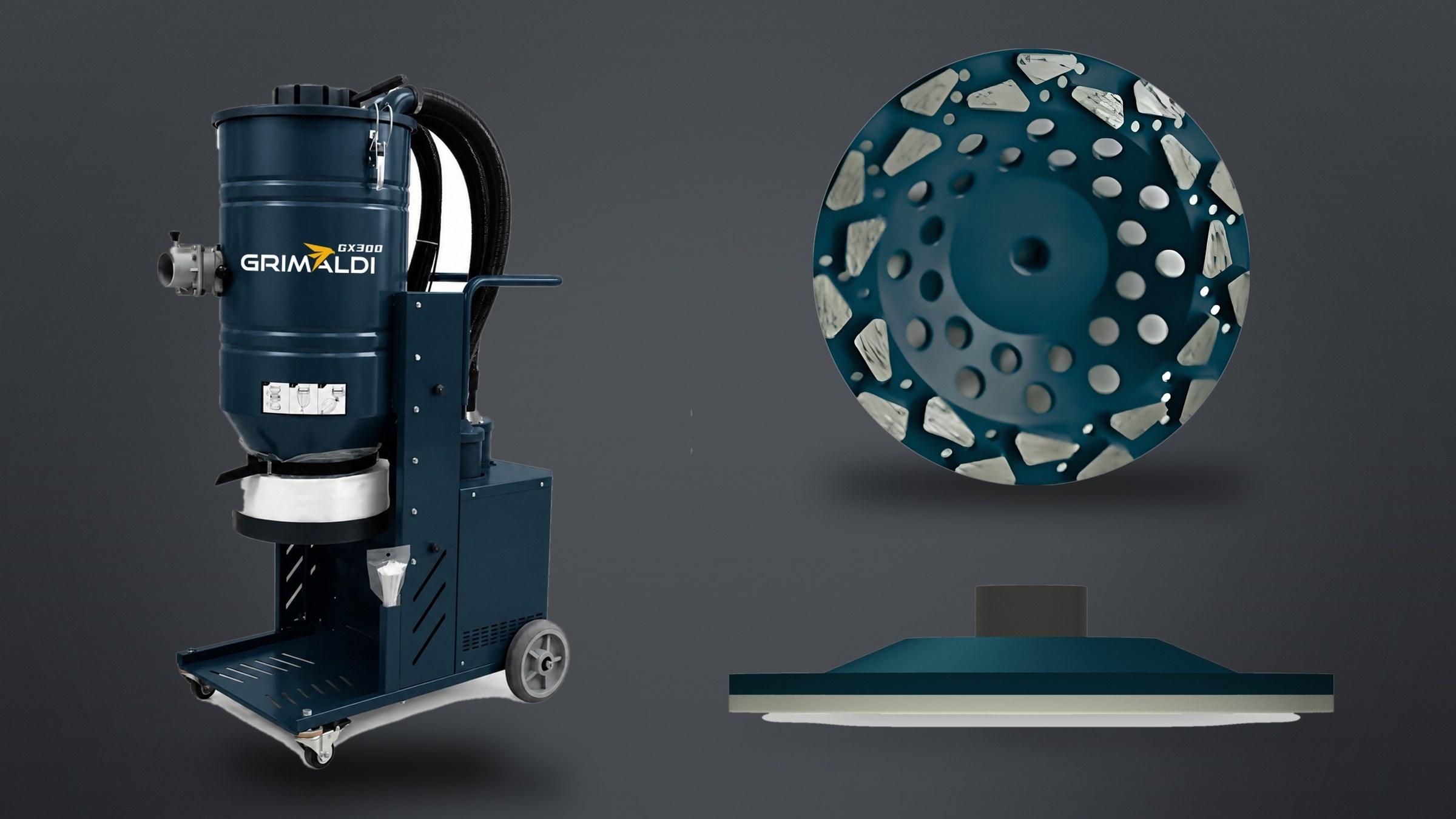
Use a machine with a fine membrane filter. All Grimaldi extractors, from the GX300 to the JTXP220 turbine, use a polyester PTFE membrane filter and clean it automatically while you work.
Keep filters fitted and in good condition. Never run an extractor with a damaged or missing filter. Keep a spare, such as the CSX2V3 replacement filter.
On bag collection machines, the GRV-1050 collection bag seals the dust in a 5.5 micron bag so emptying does not put it back in the air.
4. Clean up without making more dust
WorkSafeBC names dry sweeping and blowing with compressed air as common ways silica dust gets released at work. Clean up with the extractor or a vacuum with a high efficiency filter instead, and empty and change bags and filters following the machine's manual. If suction fades during clean up, see why a dust extractor loses suction.
5. Protect the crew
Use a fitted respirator suited to the task as part of your plan, along with eye protection. The extractor reduces dust; it does not replace the rest of the plan.
WorkSafeBC silica checklist for floor prep
Silica exposure control plan written and shared with the crew
Shroud on every grinder, connected to an extractor sized for the wheel
Filter fitted, in good condition, spare on site
No dry sweeping, no compressed air
Respirators and eye protection as the plan requires
Stripping an old coating? See how to remove an old floor coating. Questions about which extractor fits your grinders? Contact us and we will help you size it.
Questions contractors ask
Do I need an exposure control plan to grind concrete in BC?
WorkSafeBC asks employers whose work creates silica dust to develop and put in place a silica exposure control plan. See WorkSafeBC's silica page and the OHS Regulation for the rules themselves.
What is the silica control tool?
A free tool built by the BC Construction Safety Alliance. You enter the task, the material and your controls, and it helps you build the plan.
Is a respirator enough on its own?
No. WorkSafeBC is clear that PPE is the least effective control and should be used with at least one other control, such as a shroud connected to an extractor.
Can I dry sweep concrete dust?
WorkSafeBC names dry sweeping and compressed air as common ways silica dust gets released. Clean up with the extractor or a vacuum with a high efficiency filter.